
PPGL & GL STEEL | AZ150 ALUMINIUM-ZINC COATING | PROFESSIONAL ROOFING APPLICATIONS
AZ150 Steel: Understanding the Quality Behind Long-Lasting Roofing
When purchasing roofing steel, colour, thickness and price are often the first things buyers compare. However, one of the most important factors influencing the long-term performance of a steel roof is something that may not be immediately visible: the metallic coating protecting the steel underneath.
At MILLINK®, the focus is on supplying pre-painted Galvalume steel (PPGL) and Galvalume steel (GL) with clearly defined product specifications, including AZ150 aluminium-zinc alloy coating, for professional roofing applications.
MILLINK products are intended for roofing manufacturers, building-material suppliers, contractors and project buyers who value reliable specifications and consistent product quality.
A good roof begins long before installation. It begins with selecting the right steel.
1. What Is AZ150 Galvalume Steel?
AZ150 refers to the mass of the aluminium-zinc alloy coating applied to the steel substrate.
UNDERSTANDING AZ150
150 g/m²
Total metallic coating mass, both sides combined
AZ150 does not mean 150 grams on each side. It means a nominal total coating mass of 150 grams per square metre across both surfaces, subject to the applicable product standard and testing requirements.
Galvalume-type coatings typically consist of approximately 55% aluminium, 43.4% zinc and 1.6% silicon by mass.
These materials work together to provide corrosion protection. Aluminium contributes barrier protection, while zinc provides sacrificial protection, particularly at exposed areas.
The result is a metallic-coated steel designed for improved atmospheric corrosion resistance compared with ordinary uncoated steel.
2. Why AZ150 Matters for Roofing Performance
A steel roof is constantly exposed to changing weather conditions. Rain, humidity, sunlight, airborne pollutants and temperature changes can all influence its performance.
The metallic coating plays an important role in slowing corrosion of the steel substrate.
Three important advantages of a properly specified AZ150 coating:
- Corrosion protection: The aluminium-zinc alloy helps protect the underlying steel against atmospheric corrosion.
- Long-term material performance: An appropriate coating mass supports durability when matched with the local environment, correct design and proper maintenance.
- Greater specification confidence: A defined coating requirement allows professional buyers to request test reports and compare materials on a more meaningful basis.
AZ150 is not a guarantee that steel will never corrode. Roof design, coastal exposure, cut edges, installation methods and maintenance also affect service life.
This is why MILLINK encourages buyers to evaluate the complete roofing system, not simply the appearance of the finished sheet.
3. PPGL and GL Steel: What Is the Difference?

PPGL — Pre-Painted Galvalume
Aluminium-zinc coated steel with an additional factory-applied paint system for colour, appearance and surface protection.

GL — Galvalume
Aluminium-zinc coated steel supplied without a decorative pre-painted finish, with a metallic surface appearance.
Both product types can be manufactured into roofing profiles, cladding and other building components, subject to the correct material grade and forming requirements.
PPGL is particularly suitable when architectural colour and finish are important. GL offers a metallic finish for applications where a painted surface is not required.
4. Understanding the Layers of MILLINK PPGL Steel
A quality pre-painted roofing sheet is more than steel covered with coloured paint. It is a combination of materials, each serving a different purpose.
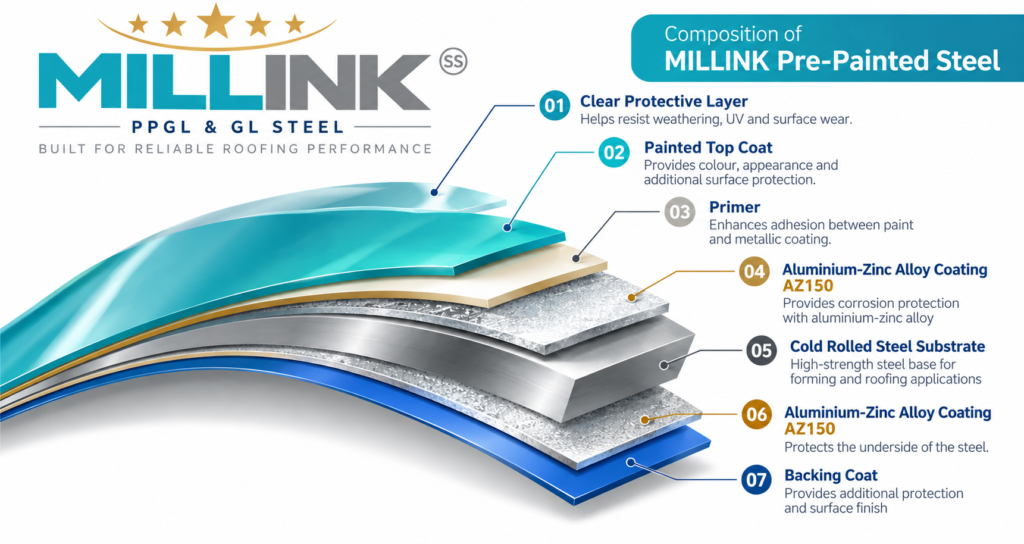
Illustration of a typical pre-painted aluminium-zinc coated steel system. Actual paint and coating specifications depend on the product ordered.
The main layers include:
- Topcoat: Provides the visible colour and helps resist weathering.
- Primer: Supports adhesion between the paint and the prepared metallic surface.
- AZ150 metallic coating: Protects the steel against corrosion.
- Steel substrate: Provides the mechanical strength required for forming and roofing applications.
- Reverse-side coating: Helps protect the underside of pre-painted steel.
Each layer contributes to the final product’s performance. Even an attractive topcoat cannot compensate for unsuitable steel thickness, poor coating adhesion or inadequate corrosion protection.
For this reason, MILLINK encourages professional buyers to understand the full material specification.
5. Is AZ150 Better Than AZ70 or AZ100?
The numbers AZ70, AZ100 and AZ150 refer to different metallic coating masses.
| Coating designation | Nominal coating mass |
|---|---|
| AZ70 | 70 g/m² |
| AZ100 | 100 g/m² |
| AZ150 | 150 g/m² |
| AZ165 | 165 g/m² |
All figures refer to the total coating on both sides, and actual compliance must be assessed against the relevant standard.
A higher coating mass generally provides a greater reserve of protective metallic coating, but it does not mean the roof will last an exact number of additional years.
For exposed roofing applications, AZ150 is an established specification used internationally.
MILLINK’s AZ150 positioning is based on offering buyers a defined, meaningful specification rather than relying only on vague descriptions such as premium steel or high quality roofing.
6. Why Steel Thickness Is Equally Important
Steel thickness affects stiffness, strength, forming behaviour and the suitability of a roofing sheet for a particular installation.
Two steel coils may have the same AZ150 coating, but different thicknesses and mechanical grades.
This can influence their performance under wind loads, roof spans and installation conditions.
Buyers should therefore check the base metal thickness (BMT), metallic coating mass, steel grade and finished coated thickness separately.
A thicker sheet is not automatically a better roofing product if the coating system or steel grade is unsuitable.
The correct combination matters more than any single specification.
7. How Proper Installation Protects Your Roofing Investment
Even well-manufactured AZ150 roofing steel can experience premature damage if installation and maintenance are neglected.
Important practices include removing cutting swarf and metal particles, preventing debris accumulation, using compatible fasteners, avoiding unsuitable chemicals and providing adequate drainage.
In coastal or highly aggressive environments, buyers should also assess whether AZ150 is suitable or whether additional protective measures or a different specification are required.
Research on aluminium-zinc coated steel shows that cut-edge corrosion behaviour can vary with environmental exposure and coating mass.
This is why MILLINK believes roofing performance depends on three connected factors: material quality, correct installation and appropriate maintenance.
8. Why MILLINK Is Developed for Professional Buyers
MILLINK is positioned for businesses that need more than a colour chart and a price per tonne.
Roofing manufacturers require materials that can be formed consistently. Wholesalers need specifications they can explain to customers. Contractors need suitable materials for the conditions of their projects.
MILLINK aims to support these requirements through clear product identification, specification-led purchasing and practical product information.
The brand’s philosophy is simple:
Built for Reliable Roofing Performance.
It means choosing materials with attention to their intended use, understanding the protective coating and helping buyers make informed decisions before placing an order.
9. Frequently Asked Questions About AZ150 Steel
Does AZ150 mean the steel is 0.150 mm thick?
No. AZ150 describes the metallic coating mass, not the steel thickness.
Is AZ150 suitable for coastal roofing?
It may be suitable for certain coastal environments, but distance from the sea, salt exposure, local corrosion category, paint system and maintenance requirements must be assessed.
Can AZ150 steel rust?
Yes. Aluminium-zinc coatings slow corrosion, but they do not make steel completely corrosion-proof.
What is the difference between PPGL and PPGI?
PPGL uses an aluminium-zinc alloy-coated substrate, while PPGI commonly refers to pre-painted galvanised steel with a predominantly zinc metallic coating. Their performance depends on the coating mass, paint system and exposure conditions.
How can buyers verify AZ150?
Buyers can request mill test certificates and, where necessary, independent coating-mass testing using the relevant recognised standard.
Does AZ150 automatically come with a warranty?
No. Warranty coverage depends on the manufacturer or supplier’s written terms, product specification, environment and approved application.
10. Choose Roofing Steel by Specification, Not Appearance Alone
A roofing sheet may look attractive on the day it is installed. Its real performance becomes evident through years of exposure to the environment.
Understanding AZ150 helps buyers ask better questions, compare quotations more accurately and select roofing materials suited to their projects.
MILLINK is developed around this principle: providing professional markets with roofing steel products supported by meaningful specifications and clear product information.
MILLINK — PPGL & GL STEEL
Built for Reliable Roofing Performance.
For product specifications, commercial enquiries or distribution opportunities, contact your authorised MILLINK supplier.

VISIT MILLINK PPGL & GL STEEL SUPPLIER